

Introduction
Have you ever seen a child with their hair standing on end from static electricity? It’s a fascinating and amusing sight!
Electricity causes this amazing effect. In fact, electrical events are some of the most fascinating phenomena in the universe.
In this article, we will explore three key questions:
- How do physicists understand electricity?
- What is an electric charge?
- How do electric charges interact?

How is electricity viewed in physics?
Everything around us is made up of positive and negative charges. Think of these charges as the essential ingredients that create all matter.
When we talk about positive charges, we are referring to protons. When we talk about negative charges, we are referring to electrons.
An object becomes electrically neutral when it contains an equal number of positive and negative charges.
For example, when you walk up to a table and touch it, you usually don’t receive a shock. Why? Because the table is not electrically charged. It contains a balanced amount of positive and negative charges, keeping it electrically neutral.
What is an electric charge?
A charge can be positive or negative.
And both have a property called an electric field.
The relationship between two opposite charges is attractive (pull in).
And the relationship between two like charges is repulsive (push away).
It’s similar to a magnetic north near a magnetic south – attractive.
And a magnetic north near a magnetic north – repulsive.
Around a magnet there is a magnetic field, when iron is in that field, the iron feels a force and it accelerates.
Around an electrically charged object there is an electric field.
Opposite charges will accelerate towards the other.
This acceleration is what we call electricity.
When the two types of charges are close, they bond together.
The word “bond” is used in chemistry for good reason.
These scientists are most concerned about electric forces.
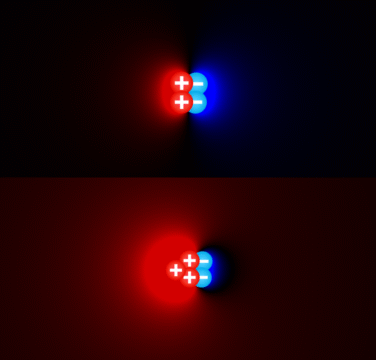
In the top image you see a model of the same amount of positive to negative charges, in balance or electrically neutral. In the bottom image, you see a model having a different amount of positive to negative charges, this is what we describe as being charged.
How do charges interact?
When charges rush towards each other we call this electricity.
When you buy a battery, all of the charges inside are separated (i.e polarised) ready to rush towards each other. How do we make that happen?
By simply connecting a wire to the positive and negative terminals.
In nature, when the ground has a different charge from the cloud there is the potential for lightning.
Lightning is what you see when charges rush towards each other, again we call this electricity.
In winter, the humidity is often at its lowest.
Now, image you are walking on the carpet in your home, feet rubbing against the floor, you are secretly charge up. You reach out to touch the door and ZAP!
The “ZAP” is what happens when negative charges move towards positive charges. And that rush of energy is called electricity.
To play with this idea we have an interactive called John TraVolta.
1. drag the foot
2. point the finger to the door knob
3. ZAP!!!
Conclusion
All things contain positive and negative charges, and they have a property called an electric field.
And when they are out of balance not having equal amounts of both – it is charged. This is a charge differential!
A charged object can create a rush of energy called electricity.
This is when opposite charges accelerate towards each other to become electrically neutral.
I hope you see, electricity is purely the effect, natures violent disturbance before the calm.
Author: Jeremy Barton
Date: 18 Oct 2026